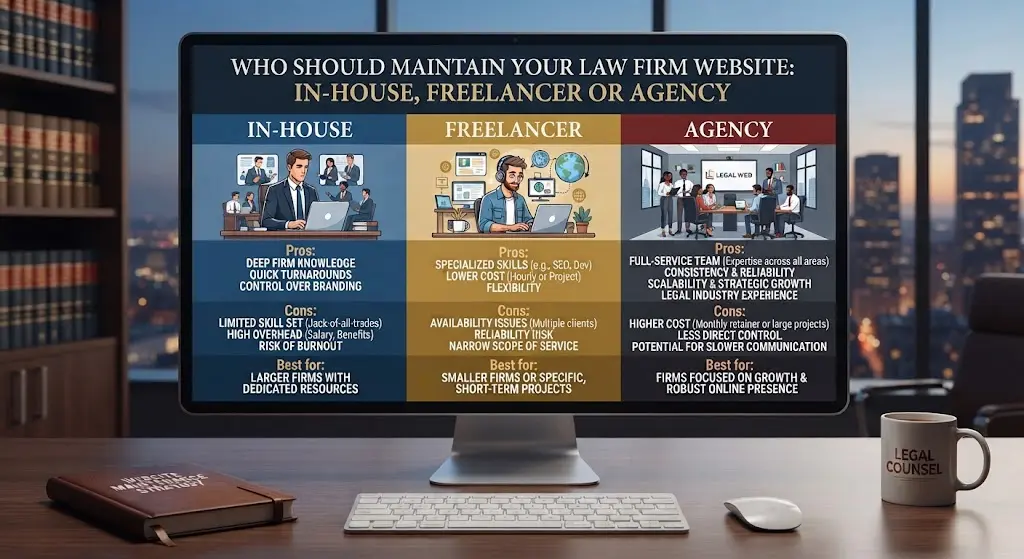

Our law firm website maintenance and hosting guide covers what maintenance actually involves. This article answers a different question: who should actually be doing it — someone on staff, a freelancer, or a specialist agency.
Option 1: In-House Staff
Having a paralegal or office manager handle basic content updates works for very small content changes, but WordPress maintenance — security updates, backups, malware monitoring — requires specific technical knowledge most legal staff simply do not have, and should not be expected to develop on top of their actual job. See law firm website security: the baseline every firm needs for what that technical baseline actually includes.
Best for: Simple text and photo updates only. Not suitable for: Security, backups, or technical troubleshooting.
Option 2: A Freelancer
A freelance developer can handle both content and technical maintenance, often at a lower monthly rate than an agency. The risk is availability and continuity — a single freelancer can become unavailable, slow to respond, or simply stop taking on the work, leaving the firm without support at an inconvenient moment.
This same trade-off applies to the original build itself, not just maintenance — see agency vs freelancer for your law firm website.
Best for: Firms comfortable with some risk in exchange for lower cost. Not suitable for: Firms that need guaranteed rapid response during an emergency.
Option 3: A Specialist Agency
A dedicated maintenance provider offers process consistency, a team rather than a single point of failure, and typically a defined response-time commitment. This usually costs more than a freelancer but removes the continuity risk entirely.
Part of that consistency is a properly tested backup process — see backups and disaster recovery for law firm websites.
Best for: Firms that want predictable, guaranteed support. Not suitable for: Firms on an extremely tight budget with very simple needs.
A Realistic Example of the Freelancer Risk Playing Out
A small firm hires a freelancer for $75/month to handle updates and backups. For a year, it works fine — responsive, reasonably priced. Then the freelancer takes on a full-time job and stops responding to messages within a normal timeframe. Three weeks later, a plugin conflict takes the site offline entirely, and the firm has no one to call — the freelancer eventually responds, but not for four days, during which the firm’s primary lead-generation channel simply does not exist. This is not a freelancer being unreliable in a moral sense; it is the structural risk of depending on a single person with no backup coverage, which a multi-person agency team does not carry in the same way.
Side-by-Side Comparison
| In-House | Freelancer | Agency | |
|---|---|---|---|
| Cost | Staff time only | $50-$150/month | $97-$300/month |
| Technical depth | Very limited | Good, if skilled | Full, guaranteed |
| Continuity risk | N/A | High | Low |
| Response time guarantee | None | Rarely formal | Usually defined |
How This Decision Shifts With Firm Size
A brand-new solo practice with a very simple site and genuinely minimal budget can reasonably start with a freelancer, accepting the continuity risk as a short-term trade-off. A small firm with 2-4 attorneys, where the site is already generating meaningful leads, should weigh that risk more carefully — the cost of downtime scales with how much the site is actually contributing to intake. A larger multi-attorney or multi-location firm should treat a specialist agency as close to non-negotiable, since the site is typically core infrastructure at that scale, and the coordination overhead of managing multiple location pages and attorney profiles benefits from a dedicated team’s processes rather than one person’s available hours.
Questions That Settle the Decision
How much does an hour of downtime actually cost your firm in missed leads? How comfortable are you with a single point of failure if your freelancer becomes unavailable? Does anyone on staff have the specific technical skill needed, or would this be an unfamiliar burden? For most firms beyond a very small budget, the answers point toward a specialist agency — the guaranteed continuity is worth the modest cost difference over a freelancer.
Common Questions About Who Should Maintain Your Site
Can I switch from a freelancer to an agency later without disruption?
Yes, as long as the freelancer used standard WordPress practices — an agency can typically take over an existing WordPress site with admin access, regardless of who built or previously maintained it.
Is it reasonable to use one provider for hosting and a different one for maintenance?
Possible, but it adds coordination overhead — when something breaks, you want one clear point of accountability, not two vendors potentially pointing at each other.
Can a firm switch maintenance providers without downtime?
Yes, if planned properly — confirm admin access is transferred cleanly, request a final backup from the outgoing provider before the switch, and schedule the handoff during a low-traffic period as an extra precaution. A well-documented WordPress site with standard practices makes this transition largely uneventful for visitors, who should never notice a change occurred.
What questions should I ask a freelancer to reduce the continuity risk?
Ask directly what happens if they become unavailable — do they have a backup contact, documented processes, or a way for another developer to take over quickly. A freelancer who has thought this through and can answer clearly is a meaningfully lower risk than one who has not considered it.
Does an in-house option ever make sense for a larger firm?
Only if the firm is large enough to justify a dedicated, appropriately skilled IT hire — which is rare even for sizable law firms, since website maintenance alone rarely justifies a full-time technical role compared to outsourcing it.
Is it reasonable to negotiate a shorter contract term with a maintenance provider?
Yes — a month-to-month arrangement, or a contract with a reasonable cancellation notice period, gives a firm flexibility to switch providers if the relationship is not working out, without being locked into a long commitment upfront.
Bottom Line
For most firms, a specialist agency offers the best balance of technical depth, continuity, and predictable cost — the modest premium over a freelancer buys real risk reduction. Attorney Website Designers structures maintenance as a team responsibility specifically so no single person’s availability becomes a single point of failure. See our maintenance plans →
Attorney Website Designers provides reliable, guaranteed-response maintenance for the law firm websites we build. Book a free 15-minute call to see what’s included.