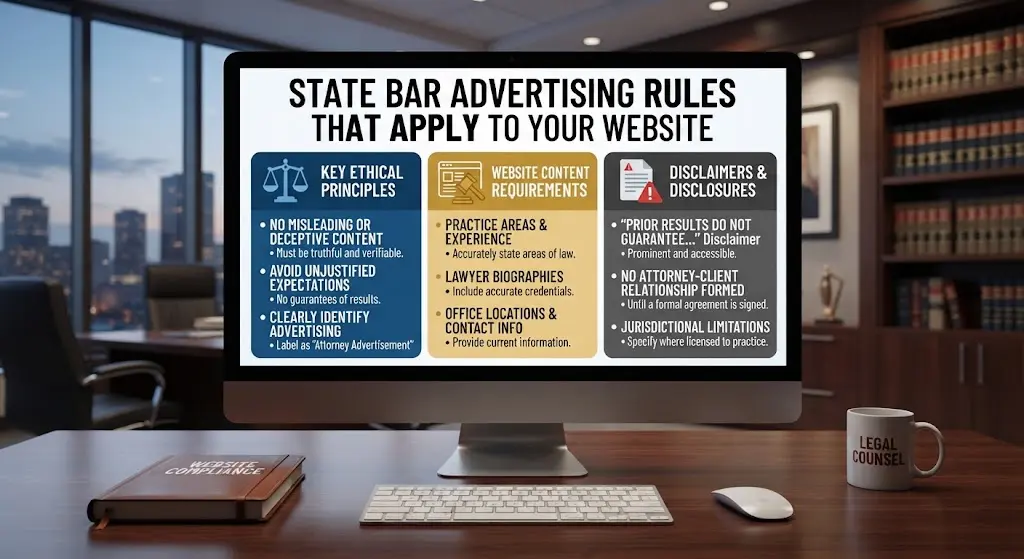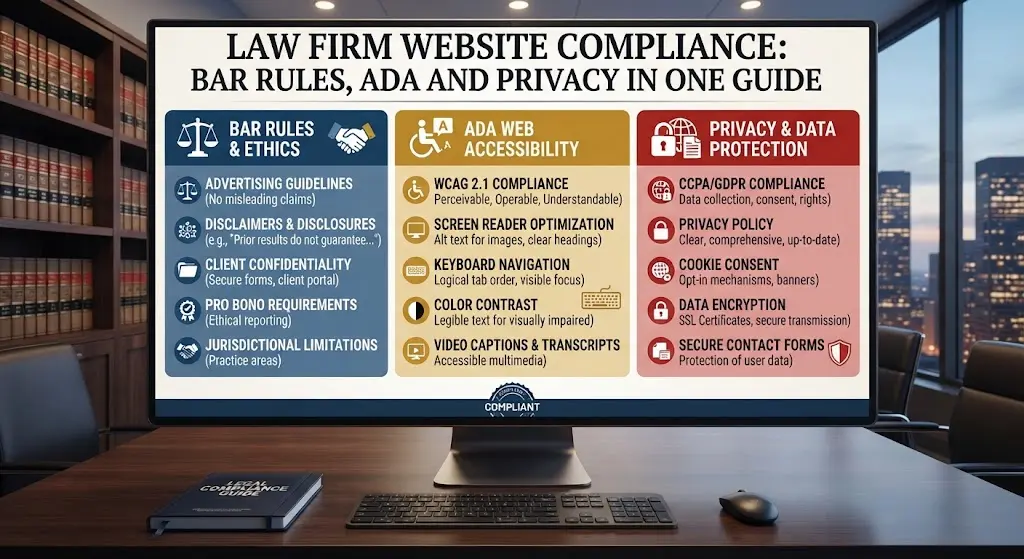

Our law firm website compliance guide covers the full picture across bar rules, ADA, and privacy. This article goes deeper specifically on state bar advertising rules — the area with the most jurisdiction-by-jurisdiction variation.
Why This Requires Checking Your Own State Directly
Every state bar sets its own advertising rules, and they change periodically. Nothing in this article substitutes for checking your own state bar’s current rules directly, or consulting counsel — this is meant as an orientation to what kinds of rules exist, not a substitute for jurisdiction-specific research.
Common Categories of Rules Across States
Disclaimers on results and testimonials. Nearly universal requirement that past results do not guarantee future outcomes, though exact wording and placement requirements vary.
Specialization claims. Many states restrict using words like “specialist” or “expert” unless formally certified by an approved certifying organization.
Attorney identification. Most states require clear identification of the responsible attorney and their bar admission, not just a firm name.
Retention of advertising records. Some states require firms to retain copies of website advertising content for a set period, which has implications for how site changes are tracked and archived.
Multi-State Practice: The Strictest Rule Applies
A firm licensed in multiple states, or marketing to clients across state lines, generally needs to comply with the strictest applicable rule among all relevant jurisdictions — not just the rule where the firm is physically headquartered. This is a common gap for firms expanding into new states without revisiting their site’s compliance language.
A Concrete Example of How Rules Differ
Consider two hypothetical states handling case results differently. State A might require a general disclaimer placed anywhere reasonably visible on the same page as the result. State B might require the disclaimer to appear in a specific minimum font size, directly adjacent to each individual result rather than once at the bottom of the page. A firm operating in both states, using a single template disclaimer placed only at the page footer, would satisfy State A’s requirement but fail State B’s more specific placement rule. This is exactly why a generic, one-size disclaimer copied from another firm’s site or a template is risky — it may satisfy the loosest applicable rule while missing a stricter one in a state where the firm also practices.
Where to Find Your State’s Actual Rules
Your state bar’s official website typically publishes its Rules of Professional Conduct, usually within a section specifically addressing advertising and solicitation. Search “[your state] bar rules of professional conduct advertising” to find the current official text directly.
Building a Simple Review Cadence
Rules do not change constantly, but they do change — a bar association updating its advertising rules every few years is common. A reasonable practice is an annual check: search your state bar’s current rules of professional conduct, skim the advertising section specifically for anything new, and compare it against what is currently live on your site. This takes under thirty minutes a year and catches drift before it becomes a real problem, rather than discovering during a bar inquiry that a rule changed eighteen months ago and the site was never updated.
How Rules Get Implemented on the Actual Website
Once you know the specific requirement, a developer translates it into practice: a disclaimer footer visible on every page, a specific line near testimonials, or language embedded in the site’s structure so it appears consistently rather than needing to be manually added to every new page. This is exactly the kind of detail our 15 must-have features guide touches on as part of a properly built site.
Common Questions About State Bar Advertising Rules
Do these rules apply to social media and Google Business Profile too, or just the website?
Generally yes — most state bar advertising rules apply to any public-facing attorney communication, not just the website specifically, though enforcement focus can vary by platform.
What happens if a website is found non-compliant?
Consequences vary by state and severity, ranging from a request to correct the content to formal bar discipline in serious or repeated cases — another reason proactive compliance review is worth the modest time investment.
Are these rules different for solo practitioners versus larger firms?
No, the rules apply the same way regardless of firm size — a solo attorney’s website carries identical advertising compliance obligations as a large firm’s site, and bar associations do not treat smaller practices with any lighter scrutiny.
Do paid ads (Google Ads, social media ads) follow the same rules as the website itself?
Generally yes, and often more strictly enforced, since paid advertising is explicitly and visibly promotional. Any disclaimer language required on the website should typically extend to paid ad copy and landing pages as well.
Who at the firm should be responsible for keeping up with rule changes?
Whoever oversees marketing or compliance, working alongside the website developer — the developer implements the technical placement correctly, but tracking the actual legal changes is a firm responsibility, not something a developer can be expected to monitor independently. Setting a simple annual calendar reminder to check for updates is often enough to stay current.
Do these rules apply to a firm’s own social media posts too?
Generally yes — an attorney’s organic social media posts promoting the firm’s services are typically treated as advertising subject to the same core disclaimer principles as the website itself, though enforcement and specific requirements can vary by state and platform. A results-focused social media post without the required disclaimer carries the same compliance risk as the same content on the website.
Bottom Line
Always confirm the specifics with your own state bar or counsel — but building your site with a developer who already knows these categories of rules exist saves real time and risk. Attorney Website Designers checks every client site against current state bar advertising rules before launch, not after. See how we build compliance in from the start →
Attorney Website Designers builds law firm websites with attorney advertising compliance built in, exclusively for attorneys across the USA. Book a free 15-minute call to see our process.