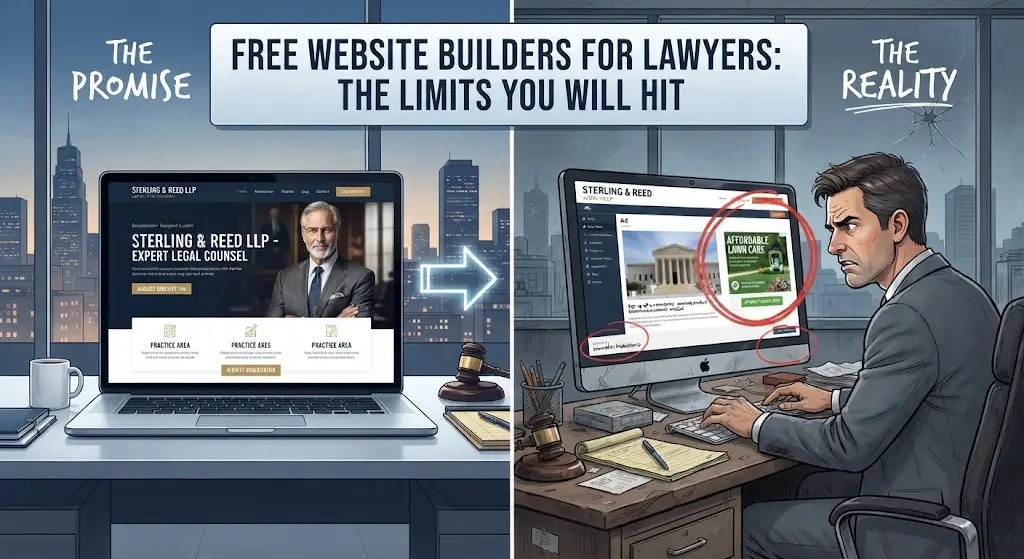

“Free” is the most tempting word in web design, and the most misleading one. Every free website builder — Wix’s free tier, WordPress.com’s free plan, GoDaddy’s basic offering — comes with real limits that show up fast for a law firm specifically. This covers exactly what “free” actually gets you, and where it stops working.
What “Free” Actually Means
Free tiers exist to convert you to a paid plan, not to provide a permanent professional solution. They are intentionally limited — enough to get a taste of the platform, not enough to run a real business on indefinitely.
Limit 1: No Custom Domain
Most free tiers give you a URL like yourfirm.wixsite.com/name instead of yourfirm.com. For a law firm, this alone undermines credibility — clients researching an attorney expect a professional domain, and a platform-branded URL signals an unfinished, non-serious operation.
Limit 2: Platform Branding You Cannot Remove
Free plans typically display the platform’s own ads or a “built with [platform]” badge on every page — not something you control, and a visible signal to visitors that this is a free, unpaid site.
Limit 3: No Real SEO Control
Free tiers almost universally strip out the SEO features available on paid plans — custom meta tags, schema markup, sitemap control. A free-tier site is structurally handicapped in search results before you have written a single word of content.
Limit 4: Storage and Bandwidth Caps
Free plans cap storage and monthly visitor bandwidth low enough that a firm getting real traction can hit the ceiling — at which point the site can slow down or display errors until you upgrade, at the exact moment your marketing is starting to work.
Limit 5: No Real Contact Form Functionality
Many free tiers restrict contact forms to a basic version with no spam filtering, limited fields, or a low monthly submission cap — a direct problem for a law firm whose entire purpose for the site is capturing leads reliably.
A Realistic Example
A newly licensed attorney sets up a free Wix site to have something live before opening. Six weeks in, a local newspaper mentions the firm in a small article, driving a spike of curious visitors. The free plan’s bandwidth cap kicks in mid-week, and the site becomes intermittently slow to load right during the exact window when the most people are checking it out. The attorney loses an unknown number of potential leads to a technical limit that a $17/month upgrade would have prevented entirely — a genuinely bad time for a free tier’s limitations to surface.
Free vs Paid: Side by Side
| Free Tier | Paid ($17-$49/month) | |
|---|---|---|
| Custom domain | No | Yes |
| Platform branding removed | No | Yes |
| SEO controls | Minimal or none | Available |
| Storage/bandwidth | Capped low | Higher limits |
A Compliance Risk Most Attorneys Do Not Consider
Beyond the functional limits, free tiers rarely give you enough layout and text control to properly place required attorney advertising disclaimers exactly where bar rules require them. Squeezing compliance language into a rigid free template, or omitting it because the platform makes it awkward to include, creates real professional risk — a cost far more serious than anything saved by avoiding a small monthly fee.
When Free Actually Makes Sense
Genuinely only as a very short-term test — confirming a domain name is available, drafting content before committing to a paid plan, or a placeholder for a few days while a real site is being built. Treating a free tier as a real launch is treating a demo as a product.
The Realistic Next Step
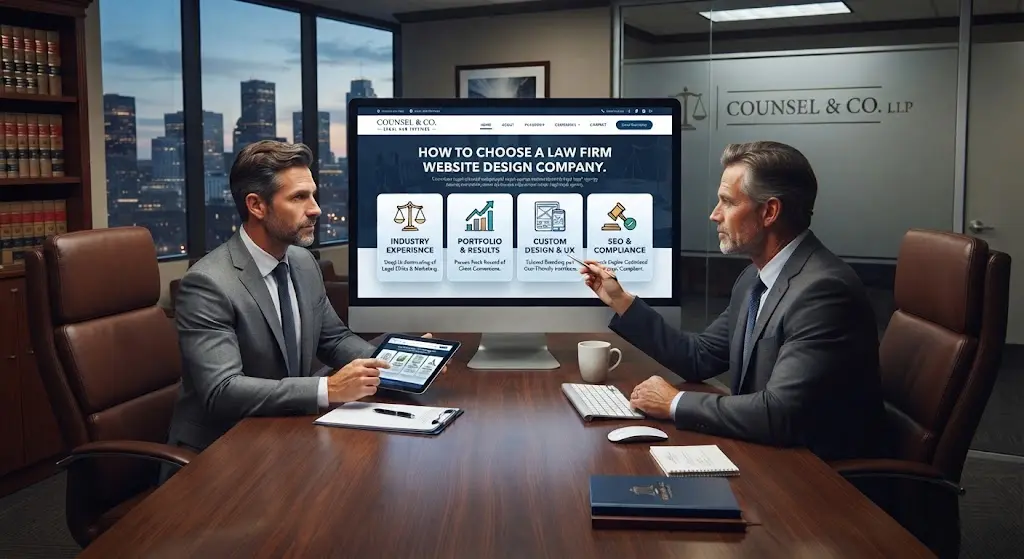
Once you are past the free tier, the real decision becomes DIY paid builder vs hiring a developer — a trade-off we cover fully in attorney website builder: DIY or hire a developer. For most firms with any budget at all, that comparison, not the free tier, is where the real decision lives.
Does a free-tier site hurt a firm’s credibility specifically?
Yes, more than most other industries — a visitor evaluating whether to trust an attorney with something significant notices small credibility signals, and a URL like “yourfirm.wixsite.com/yourfirm” or a visible platform badge in the footer reads as unfinished or under-resourced. This matters more for law firms than for a personal hobby blog, since the entire purpose of the visit is evaluating trustworthiness.
Common Questions About Free Website Builders
Can I add a custom domain later without losing my free-tier content?
Usually yes — upgrading typically preserves content while unlocking the domain and other paid features, though check the specific platform’s policy before relying on this, since some builders restructure content during the upgrade process.
Is a free WordPress.com site the same as self-hosted WordPress?
No — WordPress.com’s free tier is a closed, limited hosted product, meaningfully different from self-hosted WordPress.org, which is what specialist agencies actually use.
Do search engines penalize free-tier sites directly?
No direct penalty exists for the platform tier itself. The disadvantage is indirect — the missing SEO controls make it structurally harder to rank, not that Google treats free-tier URLs differently on principle.
How long is it reasonable to stay on a free tier?
Days to a couple of weeks at most, specifically while confirming a domain or drafting content. Beyond that window, the credibility and functional costs of staying free start outweighing whatever was saved.
Are there any legal-industry-specific risks to using a free builder’s default templates?
Yes — free-tier templates rarely include a place for required attorney advertising disclaimers, and adding this manually within a limited free editor can be more difficult than on a paid plan with fuller customization access. Confirming the disclaimer actually displays correctly on both desktop and mobile is worth checking directly, not assuming.
Bottom Line
A free website builder is a test drive, not a launch — the limits show up fast, right when the site needs to start performing. Attorney Website Designers regularly rebuilds firms off free-tier platforms once those limits start costing real leads. See what a properly built site actually includes →
Attorney Website Designers builds custom law firm websites exclusively for attorneys across the USA. Book a free 15-minute call to see what’s actually included, no hidden limits.