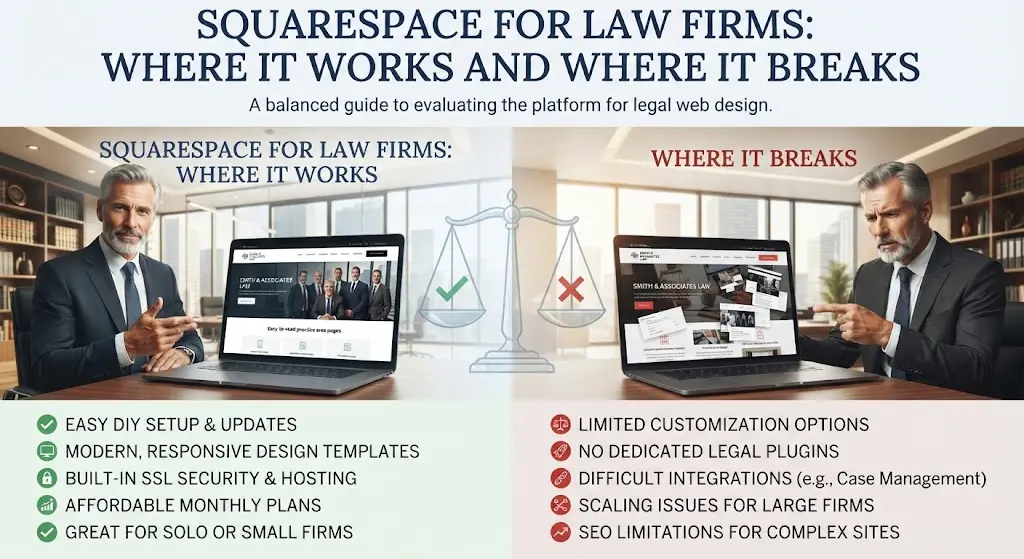

Every attorney website builder promises the same thing: a professional-looking site in an afternoon, no developer needed, no big invoice. For some firms, that promise holds up. For most law firms, it does not — not because the builders are bad tools, but because a law firm website has requirements a generic small-business builder was never designed around: compliance language, SEO that actually ranks, and a structure that converts a worried visitor into a phone call.
This guide breaks down exactly what DIY builders can and cannot do for an attorney website, what it really costs you either way, and how to make the call for your specific firm.
What “DIY Website Builder” Actually Means for a Law Firm
A website builder is a drag-and-drop platform — Wix, Squarespace, GoDaddy, or a similar tool — that lets you assemble pages from pre-made blocks without writing code. You pick a template, swap in your logo and text, and publish. No developer, no design brief, no waiting on anyone else’s schedule.
That is genuinely useful for a lot of small businesses. The question for a law firm is narrower: does that same template, built for a bakery or a plumber last week, hold up for a practice where credibility and search visibility directly drive revenue?
The Real Cost of Going DIY
The subscription fee is the visible cost — usually $16 to $40 a month. The invisible cost is your own time: choosing a template, writing every page, formatting it to look right on mobile, and troubleshooting when something breaks. For an attorney billing $200 – $500 an hour, ten to twenty hours of DIY setup is $2,000 – $10,000 of opportunity cost before the site is even live. Our full law firm website design cost breakdown covers how that compares to hiring a specialist outright.
That math alone is why many attorneys who start with a builder end up hiring a developer within the first year — not because the builder failed, but because their own time turned out to be worth more than the money saved.
What a Website Builder Can Do Well
To be fair to the tools: builders are genuinely good at a few things that matter.
- Getting a basic site live within a day, which beats having no website at all
- Low upfront cost while a solo practice is finding its footing
- No technical skill required to make small text edits later
- Built-in hosting, so there is nothing separate to manage
For a firm testing a new practice area, or an attorney who genuinely cannot spend anything upfront, that combination has real value.
Where DIY Builders Break Down for Attorneys
SEO ceiling. Builder platforms handle basic SEO — a title tag here, a meta description there — but they cap out fast. Schema markup, granular URL control, and page-speed optimization are either missing entirely or locked behind their own limitations. A law firm competing for “[practice area] attorney [city]” against specialist-built competitor sites is starting several steps behind.
Generic conversion structure. Builder templates are designed to work adequately for every business type at once, which means they work optimally for none of them. They are not built around how a worried, motivated legal client actually reads a page and decides whether to call.
Compliance blind spots. Required attorney advertising disclaimers, ADA-accessible design, and contact-form language that avoids accidentally creating an attorney-client relationship are not something a general-purpose builder template accounts for. Getting this wrong carries real professional risk, not just a design inconvenience.
Credibility signal. Legal clients are actively looking for reasons to trust or distrust a firm within seconds of landing on the page. A visibly templated site — the kind a visitor has seen for a dozen other small businesses — works against that trust before a single word is read.
No real customization at scale. Builder templates look distinctive with two or three edits. Once you need a dozen practice area pages, multiple attorney bios, and location-specific content, the platform’s structure starts fighting you — duplicate-feeling pages, awkward navigation, and layouts that were never designed to hold that much content cleanly.
For the full list of what a properly built site needs — well beyond what most builders can implement — see 15 must-have features in law firm website development.
Limited ownership and portability. Some builder platforms make it difficult or impossible to export your site if you decide to leave — your content and design stay locked inside that platform’s ecosystem. Moving to a specialist-built WordPress site later usually means starting over on structure and design, even if some of the written content can be reused.
When DIY Actually Makes Sense
A brand-new solo practice with genuinely zero budget, that needs any professional web presence live this week, is the clearest case for starting with a builder. Treat it explicitly as a placeholder — a bridge to a proper site once the practice has revenue, not a permanent home.
For the complete solo attorney website guide, see solo attorney website guide: small budget, serious results.
Considering a free tier specifically to keep costs at zero? See free website builders for lawyers: the limits you will hit before you decide.
A cheap freelance build is another common alternative at a similar price point — see our honest take in is a $500 lawyer website worth it.
When You Should Hire a Developer Instead
If you have any budget at all — even $1,000 — and you are serious about the website generating actual clients rather than just existing, hire a specialist from the start. The math from the cost section above holds: the time you would spend fighting a builder template is worth more than the price difference, and you avoid rebuilding the site a second time in a year.
A Realistic Example: What Happens Over 18 Months
Picture a solo personal injury attorney who launches on a builder in month one. The site looks decent, gets a handful of visits from people who already know the firm’s name, but ranks nowhere for “[city] personal injury lawyer.” By month six, the attorney has spent roughly 15 hours on tweaks that never quite fix the mobile layout or the slow-loading image gallery. By month twelve, a referral partner mentions the site looks dated compared to competitors. By month eighteen, the firm hires a specialist agency to rebuild from scratch — paying for a second website while the first one sits unused. Total spend: the builder subscription for 18 months, roughly 20 hours of billable time, plus the full cost of the eventual rebuild. Firms that hire a specialist from day one skip that middle stage entirely.
DIY vs Hire — Side by Side
| DIY Builder | Specialist Developer | |
|---|---|---|
| Upfront cost | $0 – $500/year | $997 – $2,997 one-time |
| Time investment | 10 – 20+ hours of your own time | 2 – 5 hours of your input |
| SEO ceiling | Basic, capped | Full technical SEO foundation |
| Compliance built in | No | Yes, when the agency specializes in law firms |
| Design uniqueness | Shared template | Custom to your practice |
| Long-term cost | Often requires a full rebuild within 1-2 years | Built to last, refreshed rather than replaced |
What a Specialist Build Actually Includes That a Builder Cannot
It helps to be concrete about the gap. A specialist attorney website build typically includes a homepage structured around how legal clients actually decide (not a generic small-business layout), individual practice area pages written for search intent rather than one combined “services” page, schema markup that tells Google specifically that this is a law firm and not a generic local business, mobile performance tuned for sub-2-second load times, and disclaimer and contact-form language reviewed against bar advertising norms. Builder platforms can approximate some of these individually with enough manual effort, but very few attorneys have the time or expertise to implement all of them correctly, and platform limitations block several of them outright regardless of effort.
If You Are Going the Builder Route Anyway
Not every builder handles legal-industry needs the same way. We tested and ranked the options specifically for attorneys in the best website builder for lawyers, covering which platforms come closest to handling SEO, compliance, and mobile performance without a developer.
The Middle Ground: Semi-Custom Templates
Between a true DIY builder and a fully custom specialist build sits a third option: a developer working from a semi-custom, attorney-specific template on WordPress. This costs less than a fully custom build — often $997 to $1,997 — while still including proper SEO setup, mobile optimization, and law-firm-aware structure that a generic builder template cannot offer. For many solo and small firms, this middle tier delivers most of the benefit of a full custom build without the full custom price tag, and it avoids the rebuild cycle that pure DIY tends to lead to.
How Long Each Path Actually Takes
A DIY build typically takes an attorney 10 – 20 hours spread over one to three weeks of evenings and weekends, depending on how much content needs writing. A specialist-built site, by comparison, usually takes 4 – 6 weeks start to finish but requires only a few hours of your own input. See the full week-by-week breakdown in how long a law firm website actually takes to build.
What to Ask Before You Decide
Whichever route you are leaning toward, ask yourself: will this site rank for the searches my ideal clients actually type? Will it hold up to bar advertising and ADA requirements? And realistically, how many hours am I willing to spend building it myself? If you decide to hire, our guide on what to ask before hiring a designer covers the right questions to vet any agency or freelancer.
Common Questions About Attorney Website Builders
Can I start with a builder and move to a custom site later?
Yes, but plan for it to be a rebuild, not a transfer. Content can usually be reused; the design and technical foundation generally cannot move over as-is.
Is WordPress considered a DIY builder?
Self-hosted WordPress sits in between. It offers far more flexibility than Wix or Squarespace, but still requires either real technical comfort or a developer to set it up properly — it is not the same afternoon-and-done experience as a true drag-and-drop builder.
See the full case for that platform in why WordPress wins for law firm websites.
If you decide to build it yourself, our step-by-step process in how to build a law firm website yourself covers exactly what to do.
Will Google penalize a site built on a DIY platform?
No direct penalty exists for the platform itself. The problem is indirect: these platforms make it harder to implement the technical SEO that helps a site rank, not that Google treats them differently by default.
What about page builders like Elementor on WordPress — are those different from Wix or Squarespace?
Somewhat. Elementor and similar WordPress page builders give a developer far more control over SEO structure and custom design than Wix or Squarespace allow, even though the drag-and-drop interface looks similar. The difference is who is doing the building — a developer using these tools professionally gets very different results than an attorney using them solo for the first time.
How much ongoing time does a specialist-built site need from me after launch?
Very little. Most specialist builds include a maintenance option that handles updates, security, and minor content changes, leaving you with essentially zero ongoing technical time beyond approving occasional content updates.
Bottom Line
A DIY builder is a reasonable placeholder for a firm with zero budget and an urgent need to exist online. For everyone else, the time and opportunity cost of building it yourself usually exceeds the cost of hiring a specialist — and you end up with a site built to actually rank and convert, not just to exist. See what a specialist-built attorney website includes →
Attorney Website Designers builds custom law firm websites exclusively for attorneys across the USA. Book a free 15-minute call to see what a specialist build would look like for your firm.