
If you have decided to go the attorney website builder route rather than hiring a developer, the platform you pick matters more than most attorneys assume. Some builders come far closer to handling SEO and mobile performance without help than others. We tested the five platforms attorneys ask about most, specifically for law firm use, and ranked them below.
None of these fully replace a specialist build — that trade-off is covered in the guide linked above — but if you are building it yourself, this is the order we would choose in.
How We Evaluated These Builders
Every platform was scored on five things that matter specifically for a law firm site, not general small-business use: how much SEO control it gives you, how it performs on mobile, how flexible it is for compliance-related content like disclaimers, how steep the learning curve is for a non-technical attorney, and total cost including any add-ons you would realistically need.
1. Squarespace — Best Overall for a Solo Attorney
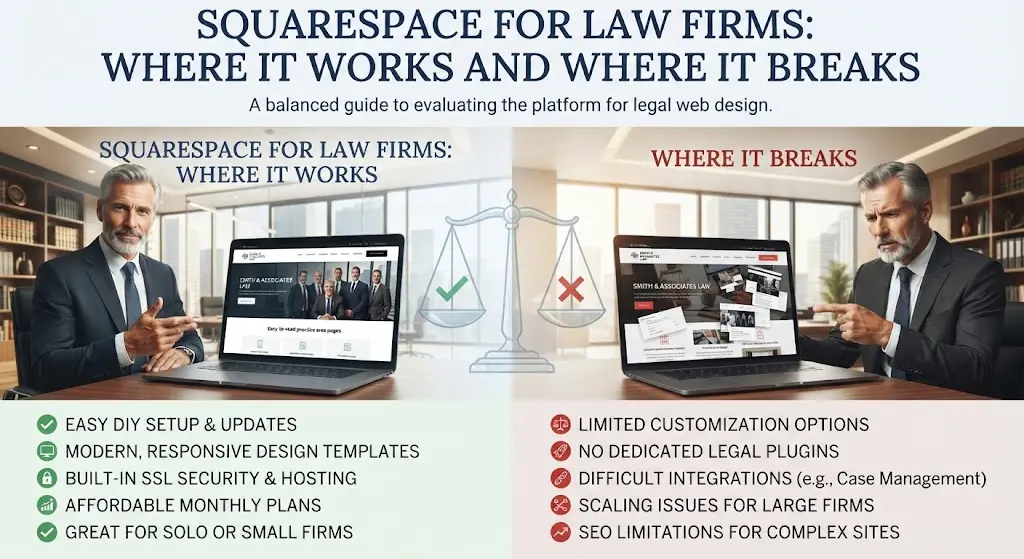
Squarespace consistently produces the most professional-looking result of any pure builder, with templates that lean editorial and trustworthy rather than corporate-generic — a genuine advantage for a solo practice. SEO controls are better than most competitors, including clean URL structure and decent meta tag control, though schema markup still requires a third-party extension.
For a deeper look specifically at Squarespace for legal use, see Squarespace for law firms: where it works and where it breaks.
Cost: $23 – $49/month. Best for: Solo attorneys who want the most polished look with the least manual tweaking. Watch out for: Limited page-speed control on image-heavy templates.
2. Wix — Most Flexible Layout Control
Wix gives you the most granular drag-and-drop control of any builder here, which is a double-edged sword — more room to build something distinctive, but also more room to build something that looks amateurish if you are not design-trained. Its SEO tools have improved significantly and now include reasonably capable schema and meta controls through its SEO Wiz feature.
For a full head-to-head against the platform most firms eventually move to, see Wix vs WordPress for law firms: a straight comparison.
Cost: $17 – $35/month. Best for: Attorneys comfortable spending real time fine-tuning layout by hand. Watch out for: Page speed drags on the free and lower tiers due to how Wix loads its editor code.
3. Self-Hosted WordPress with a Legal Theme — Best SEO Ceiling
Technically not a pure “builder,” but the option most attorneys land on once they outgrow Wix or Squarespace. Paired with a page builder plugin like Elementor and a purpose-built legal theme, self-hosted WordPress offers no real SEO ceiling — full schema control, unlimited URL structure flexibility, and access to the entire Yoast SEO or similar plugin ecosystem. The tradeoff is a genuinely steeper learning curve and the need to manage hosting and security yourself, or pay someone to.
Cost: $10 – $30/month hosting, plus $0 – $100 for a legal theme. Best for: Attorneys with some technical patience who want real SEO headroom without hiring a developer yet. Watch out for: Security updates and backups are entirely on you unless you add a managed hosting plan.
4. GoDaddy Website Builder — Fastest to Launch, Most Limited Long-Term
GoDaddy’s builder is genuinely the fastest way to get something live — often under an hour using its AI-assisted setup. That speed comes at a cost: the templates are the most visibly generic of any platform here, SEO controls are the thinnest, and there is effectively no path to the kind of custom structure a growing firm eventually needs.
Cost: $16 – $30/month. Best for: A true placeholder site while you save toward a specialist build. Watch out for: Plan on rebuilding elsewhere within 12 months if the firm is growing at all.
5. Weebly — Included with Some Domain Registrars, Weakest Overall
Weebly shows up mainly because it comes bundled free or cheap with some domain registrars, which tempts attorneys who have not budgeted for a website at all. Design flexibility, SEO tools, and mobile performance all trail the other four options here noticeably. It is workable only as an extremely short-term placeholder.
Cost: $0 – $26/month. Best for: Literally nothing beyond a temporary placeholder. Watch out for: Weak SEO control means this site is unlikely to ever rank for competitive local search terms.
Does the Right Builder Change by Practice Area?
Somewhat. A personal injury or family law solo practice, where trust and warmth matter most in the first impression, tends to do best on Squarespace’s more editorial templates. A firm handling several distinct practice areas — say estate planning and business law under one roof — usually needs Wix or WordPress for the extra structural flexibility to keep each practice area clearly organized rather than crammed into one generic services page. Immigration and criminal defense firms, where search competition tends to be highest, benefit the most from WordPress’s stronger SEO ceiling, since ranking against well-optimized competitor sites is harder in those categories.
Side-by-Side Comparison
| Builder | SEO Ceiling | Learning Curve | Monthly Cost | Verdict |
|---|---|---|---|---|
| Squarespace | Good | Low | $23 – $49 | Best overall for solo attorneys |
| Wix | Good | Medium | $17 – $35 | Best for hands-on layout control |
| WordPress + Legal Theme | Excellent | High | $10 – $30 + theme | Best SEO ceiling if you have patience |
| GoDaddy | Weak | Very Low | $16 – $30 | Fastest launch, weakest long-term |
| Weebly | Weak | Low | $0 – $26 | Placeholder only |
What None of These Builders Can Do
Even the strongest option on this list — self-hosted WordPress with a legal theme — still leaves the actual strategy to you: which practice area pages to build, how to structure them for search intent, what schema types to use, and how to write conversion-focused copy for a legal audience specifically. A platform can hand you the tools; it cannot hand you the expertise of having built dozens of attorney sites and seen what actually converts. That gap is exactly what a specialist agency closes. If you decide the DIY route is not worth the time after all, our full breakdown of law firm website design cost shows what a specialist build actually runs.
Ready to actually start building? Follow the full step-by-step process in how to build a law firm website yourself.
Before hiring anyone, our guide on what to ask before hiring a designer will help you tell a genuine legal-industry specialist from a generalist agency that just says yes to everything.
See what a specialist-built lawyer website includes →
Common Questions About Website Builders for Lawyers
Is there a free option that actually works for a law firm?
Not really. Free tiers on every platform here come with the provider’s branding, no custom domain, and the weakest SEO controls — workable for testing, not for a firm that wants to be found on Google.
Can I add a chatbot or online scheduling to a DIY builder?
Most of these platforms support basic third-party chat and scheduling widgets through their app marketplaces, though integration is rarely as clean as a custom-built site with the tool wired in directly.
Which of these is easiest to eventually migrate away from?
Self-hosted WordPress, by a wide margin — your content lives in a database you control, not locked inside a proprietary platform. Squarespace and Wix make it far harder to move your actual design and structure elsewhere later.
Do any of these builders include compliance-safe disclaimer templates for attorneys?
No. None of the five platforms include attorney-specific disclaimer language out of the box — you or a lawyer on your team need to write and place that language yourself on every builder, including WordPress.
How much does switching builders after the fact usually cost in lost time?
Plan on rebuilding most of the site rather than migrating it cleanly, since design and page structure rarely transfer between platforms. Written content is typically the only piece that carries over directly.
Attorney Website Designers builds custom law firm websites exclusively for attorneys across the USA. Book a free 15-minute call to see what a specialist build would look like compared to any of these platforms.