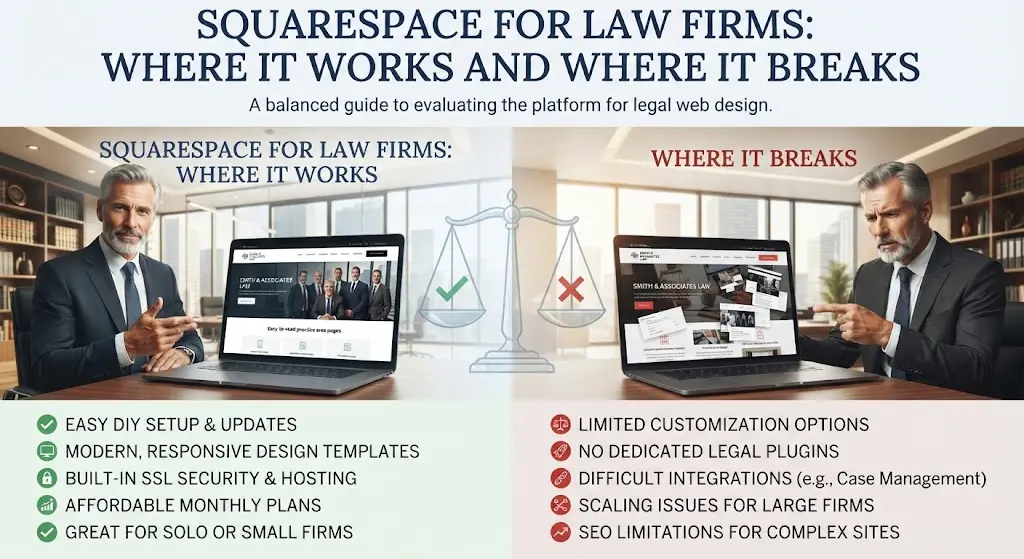

Squarespace consistently ranks as one of the better DIY options for attorneys in our broader comparison of the best website builder for lawyers — but “better than the alternatives” and “good enough for your firm” are different questions. This guide goes deeper specifically on Squarespace: where it genuinely holds up for a law firm site, and where it quietly breaks down.
Where Squarespace Works
Visual polish out of the box. Squarespace’s templates lean editorial and clean by default, producing a more professional first impression than most competing builders without requiring design skill to achieve it.
Straightforward editing. The interface is genuinely easy for a non-technical attorney to use for text and image updates, with less of a learning curve than Wix’s more open-ended editor.
Reasonable base-level SEO controls. Title tags, meta descriptions, and clean URLs are accessible without needing a plugin, which is more than some competing builders offer natively.
Mobile performance is solid but not exceptional. Squarespace templates are responsive by default, but image-heavy templates can load slower on mobile than a properly optimized WordPress build, since Squarespace controls the underlying performance optimization rather than giving you direct control over it.
Where Squarespace Breaks Down
Schema markup is limited. Structured data that tells Google specifically “this is a law firm” with practice areas and locations is either unavailable or requires third-party code injection workarounds — not native, reliable support.
Practice area page structure is awkward at scale. Squarespace handles a handful of pages gracefully, but firms with five or more distinct practice areas often find its page and navigation structure starts fighting them rather than helping.
No true ownership. Stop paying, and the site goes offline. There is no self-hosted equivalent — you are permanently a tenant on Squarespace’s platform, not an owner.
Limited plugin ecosystem. Where WordPress has a specific plugin for nearly every legal-industry need, Squarespace’s closed system means you are limited to what Squarespace itself builds or officially supports.
Analytics integration is basic. Squarespace’s built-in analytics cover visits and basic behavior, but connecting deeper tools — call tracking, conversion attribution — requires third-party integrations that do not always work as cleanly as they do on WordPress, where the plugin ecosystem is built specifically to support this kind of tracking.
A Realistic Example
A family law solo attorney launches on Squarespace and it looks great immediately — clean, professional, exactly the polish the platform is known for. A year later, the attorney adds a second focus (mediation services) and wants a dedicated page targeting that specific search intent. The template structure was not built with a clean way to add a genuinely distinct practice area page without disrupting the existing navigation, and the schema limitations mean the new page struggles to signal to Google what specific service it offers. The attorney spends several hours working around the platform’s constraints rather than simply adding the page the way it would work on a more flexible foundation.
Squarespace vs a Specialist WordPress Build
| Squarespace | Specialist WordPress Build | |
|---|---|---|
| Monthly cost | $23-$49 | Hosting only, $10-$30 |
| Ownership | None, platform-locked | Full |
| Schema/SEO ceiling | Limited | Full control |
| Scales to 10+ practice area pages | Awkward | Designed for it |
Squarespace’s Legal-Adjacent Templates
Squarespace does not offer templates built specifically for law firms, but several of its “professional services” and “consultant” category templates adapt reasonably well — clean typography, generous white space, and a structure that suits an attorney bio and a short list of practice areas. The gap shows up specifically once you need more than three or four distinct practice areas, or location-specific pages for multiple offices, since these templates were designed around a single consultant’s services rather than a firm’s full range of legal work.
Who Should Actually Use Squarespace
A solo attorney with a single practice area, minimal budget, and no near-term plan to expand practice areas is the realistic fit. Beyond that profile, the platform’s limitations start outweighing its polish. If your firm has any of those growth plans, WordPress is worth the modestly steeper starting curve — see why WordPress wins for law firm websites for the full case.
Common Questions About Squarespace for Law Firms
Can a Squarespace site be migrated to WordPress later?
Written content generally transfers with some reformatting; design and page structure need to be rebuilt, since the platforms are not directly compatible.
Does Squarespace support attorney advertising disclaimers properly?
Yes, as custom text blocks — the platform does not prevent this, but you or a lawyer on your team need to write and place that language yourself, same as any platform.
Does Squarespace offer any legal-industry-specific features?
No — there is no legal-specific version of the platform. Anything law-firm-relevant, like disclaimer placement or practice area structuring, has to be configured manually within its general-purpose templates.
Is Squarespace secure enough for a firm’s contact forms?
Squarespace handles basic security (SSL, hosting-level protections) reliably, since it is a fully managed platform. The concern with Squarespace is functionality and ownership limits, not security specifically.
Can Squarespace handle a multi-attorney firm’s bio pages?
Yes for a small team, but the platform lacks a proper custom post type system, so each new attorney bio has to be built manually rather than generated from a consistent template — manageable for two or three attorneys, tedious beyond that.
Is Squarespace cheaper than WordPress long-term?
Usually not. Once you count the years of $23-$49/month subscription against WordPress hosting at $10-$30/month with no platform fee, WordPress is typically cheaper past year two, on top of the ownership difference.
Run the actual numbers before deciding: five years of Squarespace at $35/month averages out to roughly $2,100, with nothing owned at the end. A specialist WordPress build at $1,500 plus $20/month hosting over the same five years runs about $2,700 — slightly more upfront, but the firm owns a fully custom, unlimited-scale asset at the end of it rather than a rented template. For firms planning to practice for more than a few years, that gap closes further with every year past five.
Bottom Line
Squarespace is a genuinely solid placeholder for a narrow use case, and a limiting choice for almost everything beyond it. See what a specialist WordPress build includes instead →
Attorney Website Designers builds custom law firm websites exclusively for attorneys across the USA, on WordPress. Book a free 15-minute call to see how it compares to your current Squarespace site.