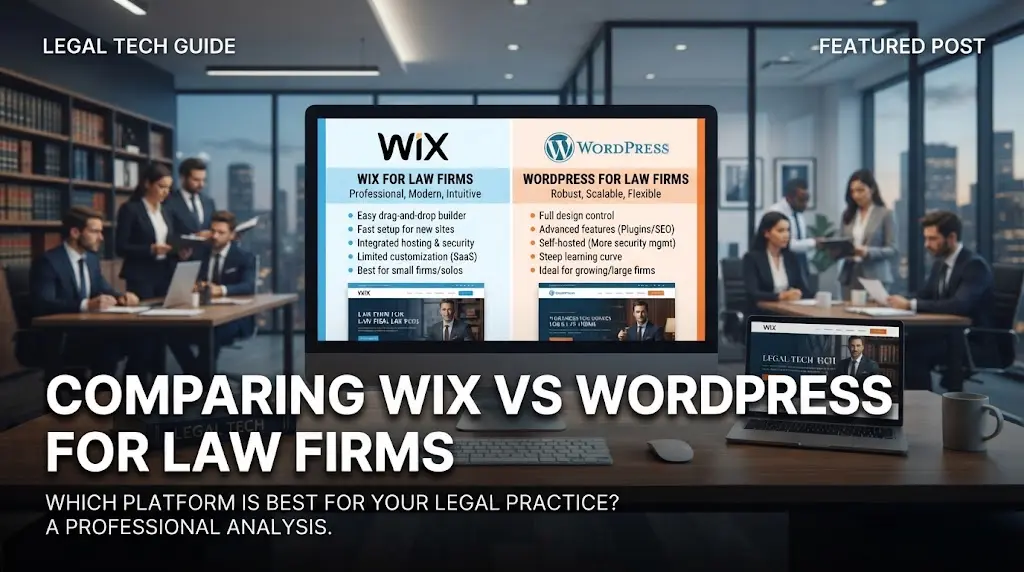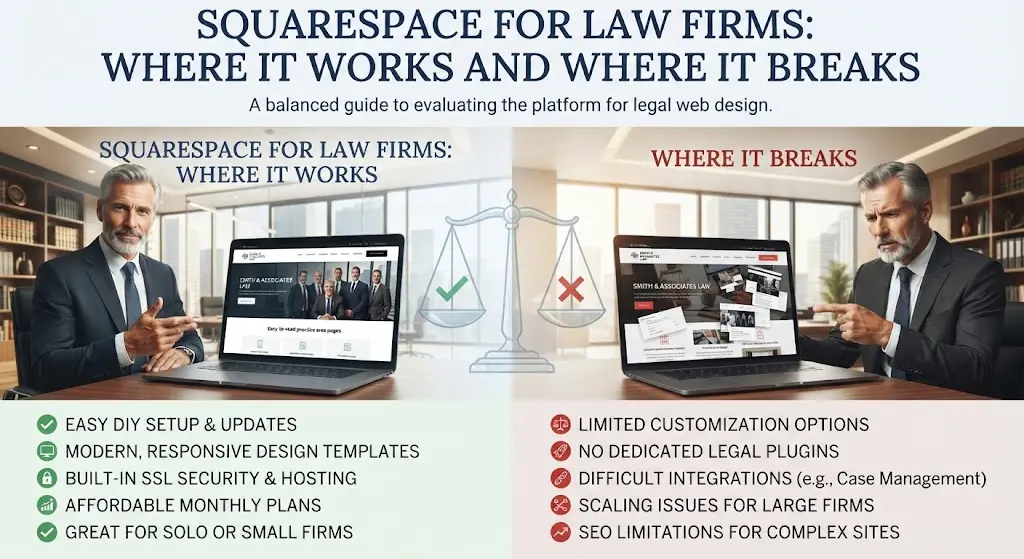

Wix and WordPress come up constantly in the same breath, but they are fundamentally different tools solving different problems. This is a straight, practical comparison specifically for law firm use — not a general web design opinion piece.
The Core Difference
Wix is a closed, hosted platform — you build within Wix’s system, on Wix’s servers, under Wix’s rules. WordPress (self-hosted) is open-source software you install on hosting of your choice, giving you full control over every layer. This single distinction drives almost every other difference between them.
Side-by-Side Comparison
| Wix | WordPress (Self-Hosted) | |
|---|---|---|
| Setup difficulty | Easy, guided | Requires technical comfort or a developer |
| Ownership | None, platform-locked | Full |
| SEO ceiling | Moderate, improving | Highest, full plugin ecosystem |
| Design flexibility | High within Wix’s editor | Highest, especially with a page builder |
| Monthly cost | $17-$35 | Hosting only, $10-$30 |
| Scales to large multi-location firm | Difficult | Built for it |
Where Wix Genuinely Competes
Wix’s drag-and-drop editor gives more granular pixel-level layout control than most other pure builders, which appeals to attorneys who want to fine-tune design themselves without touching code. Its SEO tools, through Wix SEO Wiz, have genuinely improved and now cover schema, meta tags, and sitemap generation — more than Wix offered even two or three years ago, though still short of WordPress’s depth.
Where WordPress Pulls Ahead
The gap widens specifically around three things: ownership (you can never be locked out of your own site by a billing issue or platform policy change), the plugin ecosystem (thousands of purpose-built tools versus Wix’s more limited app marketplace), and scale (a 40-page multi-location firm site is straightforward on WordPress, awkward on Wix). For the full case, see why WordPress wins for law firm websites.
Ownership: The Difference That Compounds
This is worth dwelling on because it is the difference attorneys most often underweight when comparing the two platforms. On Wix, your site exists entirely within Wix’s infrastructure — stop paying, violate a policy you were not fully aware of, or Wix changes its terms, and the site can go offline with limited recourse. On WordPress, the files and database are yours, on hosting you chose and can change at any time. If a hosting provider ever mistreats you, you can move the entire site elsewhere within days. That option simply does not exist on Wix.
Page Speed: A Direct Comparison
Wix’s editor loads a significant amount of platform code on every page, which historically hurt speed scores compared to a well-optimized WordPress build. Wix has invested in improving this, but a properly configured WordPress site with caching and image optimization still typically outperforms a comparable Wix site on real-world mobile load times — a meaningful factor given how directly page speed affects both rankings and conversion.
A Realistic Example
A small firm builds on Wix, grows from two to five attorneys over three years, and wants to add distinct pages for two new practice areas plus a second office location. On Wix, this means manually rebuilding navigation, working within the editor’s page-count-friendly but structurally rigid system, and running into schema and SEO ceiling limits exactly when the firm needs stronger rankings the most — during active growth. The same expansion on WordPress is a matter of adding new pages within an already-flexible content structure, with no platform-imposed ceiling on how the site can grow.
Which One Should Your Firm Choose?
Choose Wix if you have zero budget for a developer, want to build and control every pixel yourself, and your firm has a single practice area with no near-term growth plans. Choose WordPress if you have any budget for professional setup, want the strongest possible SEO foundation, or expect your firm to grow beyond a handful of pages within the next two to three years. For most law firms beyond the very first month of practice, that second condition applies.
Cost Over Time
Wix at $26/month averages roughly $1,560 over five years, with nothing owned at the end. WordPress hosting at $20/month over the same period runs about $1,200, and that is before counting that WordPress requires an upfront build investment Wix’s guided setup avoids. Where the two paths diverge financially is less about raw cost and more about what you have at the end: a rented site on Wix versus an owned, infinitely scalable asset on WordPress. For firms planning to practice for years, not months, that difference matters more than the monthly number.
Common Questions About Wix vs WordPress for Law Firms
Is Wix actually easier to use than WordPress day-to-day?
For initial setup, yes. For ongoing content editing after a WordPress site is properly configured, the day-to-day experience is comparable — the difference is almost entirely in setup complexity, not daily use.
Does Wix or WordPress handle attorney advertising compliance better?
Neither handles it automatically — both require you or a lawyer on your team to write and place the correct disclaimer language. WordPress offers more plugin-based tools to help manage and update this consistently across many pages at scale.
Is there a hybrid option between the two?
Not really — Wix does not offer a self-hosted export option. The closest middle ground is a semi-custom WordPress build using a pre-built legal theme, which reduces setup complexity while keeping full ownership.
Can I move from Wix to WordPress without losing my Google rankings?
With careful planning — preserving URL structure and setting up redirects correctly — rankings can largely be preserved. Done carelessly, a migration can cost significant ranking ground. Our redesign guide covers how to do this without losing Google rankings.
Does Wix have any features WordPress genuinely lacks?
Very few at this point — Wix’s main practical advantage is setup simplicity, not any specific capability WordPress cannot match or exceed through its plugin ecosystem.
Does Wix support schema markup for law firms?
Only in a limited way through third-party app integrations — WordPress’s SEO plugins offer far more direct, reliable control over LegalService and Attorney schema specifically, without relying on app-store workarounds.
Bottom Line
Wix wins on setup simplicity; WordPress wins on nearly everything a growing law firm needs long-term. See our WordPress builds in detail →
Attorney Website Designers builds custom law firm websites exclusively for attorneys across the USA, on WordPress. Book a free 15-minute call to see the difference firsthand.