
If you have read through the full law firm website development process, you already know WordPress sits at the center of the stack we recommend. This is why: not brand loyalty, but a genuine comparison of what each platform can and cannot do for a legal website specifically.
The Platform Landscape: WordPress vs the Alternatives
| Platform | SEO Ceiling | Ownership | Best For |
|---|---|---|---|
| WordPress (self-hosted) | Highest | Full | Almost every law firm |
| Squarespace / Wix | Medium | Limited, platform-locked | Zero-budget placeholder |
| Proprietary agency CMS | Varies, often limited | None — locked to that agency | Rarely recommended |
| Webflow | Good | Moderate | Design-heavy sites, smaller plugin ecosystem |
Every alternative trades away something WordPress offers by default — usually ownership, SEO depth, or both.
Ownership and Portability
A WordPress site’s content lives in a database you control, on hosting you can move at any time. If your relationship with a developer or agency ends, the site itself is not held hostage — any other WordPress developer can pick it up. Proprietary agency platforms, and to a lesser extent Wix and Squarespace, do not offer this: leaving means starting over, not migrating.
To make this concrete: a personal injury firm using a proprietary agency CMS discovered that adding a new practice area page required submitting a support ticket and waiting a week for the agency to build it, since the platform did not allow direct editing of page structure. The same task on WordPress takes a developer, or even a trained staff member, under an hour. That difference in flexibility compounds every time the firm’s needs change — a new attorney joins, a new practice area opens, or a location expands.
SEO Ceiling and Plugin Ecosystem
This is where WordPress separates most clearly from drag-and-drop builders. Plugins like Yoast SEO give granular control over schema markup, meta tags, XML sitemaps, and URL structure — the exact technical foundation a law firm site needs to compete for local and practice-area searches. Builder platforms offer basic versions of some of this, but rarely the full depth, and rarely with the flexibility to adjust as a firm’s SEO strategy matures.
Beyond Yoast itself, the wider WordPress plugin ecosystem covers nearly every specific need a law firm site runs into: schema markup for local business and legal service types, structured FAQ markup that can earn rich results in Google, and analytics integrations that go well beyond what a builder platform’s built-in reporting offers. Because these are independent plugins rather than features locked to one platform’s roadmap, they get updated and improved constantly by a much larger developer community than any single company could maintain alone.
The Learning Curve, Honestly
WordPress trades some initial simplicity for long-term flexibility. Setting it up correctly — hosting, security, initial configuration — genuinely requires either technical comfort or a developer, unlike a builder platform’s guided setup wizard. Once it is set up and handed over properly, though, day-to-day use — editing a page, updating a bio, publishing a blog post — is no harder than any builder platform’s editor. The complexity is front-loaded into the setup, not spread across ongoing use.
Security and Maintenance Ecosystem
Because WordPress powers a large share of the web, it also has the largest ecosystem of security, backup, and maintenance tools built specifically for it — and the largest pool of developers who can support it. This matters directly for ongoing care: see our guide on law firm website maintenance and hosting for what that ongoing WordPress-specific care should include.
Design Flexibility Without Starting From Code
Paired with a page builder like Elementor, WordPress offers design flexibility close to fully custom code, without the cost of building everything from scratch. This is part of why the specific list of features a legal site needs — covered in 15 must-have features in law firm website development — is realistic to implement on WordPress specifically, where a general-purpose builder often cannot support all of them.
How WordPress Scales for Multi-Attorney and Multi-Location Firms
A solo attorney’s five-page site and a fifty-page multi-location firm site can both run on the exact same WordPress foundation — the platform does not impose a page-count ceiling or force a different tier of tool as a firm grows, the way some builder platforms do with pricing plans that unlock more pages or features. Custom post types and taxonomies (technical WordPress features for organizing structured content) make it straightforward to manage dozens of attorney bios or location pages consistently, rather than manually formatting each one from scratch. This is one of the more understated reasons larger firms in particular tend to end up on WordPress even if they started elsewhere.
Cost Efficiency Over Time
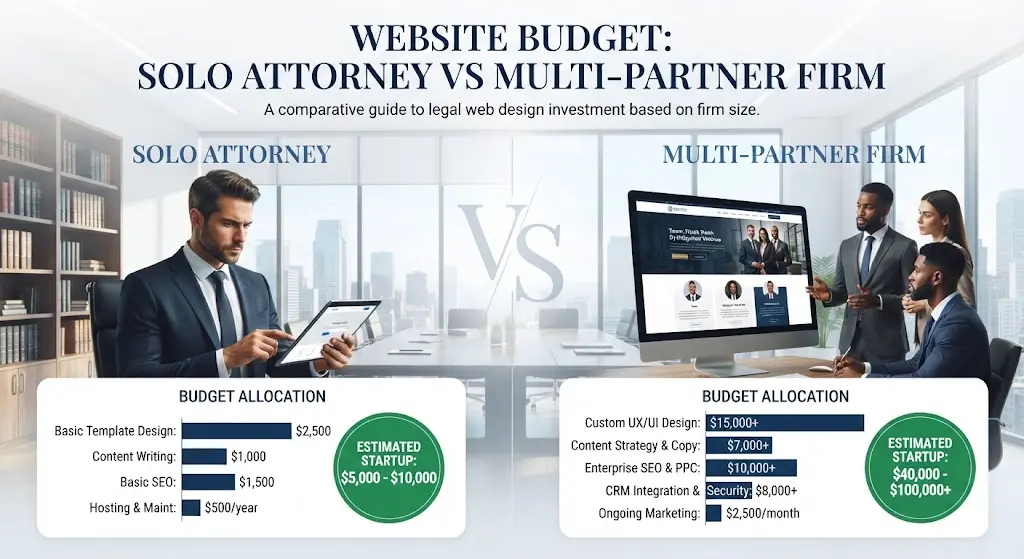
WordPress itself is free and open-source — you pay for hosting, a theme or page builder, and development time, not a platform licensing fee. Over several years, this typically works out cheaper than subscription-based builder platforms or proprietary agency systems that charge ongoing platform fees on top of any development or maintenance cost.
Concretely: a builder platform subscription running $30/month costs $1,800 over five years, with nothing owned at the end — stop paying and the site disappears. A one-time WordPress build plus reasonable hosting over the same five years typically costs less overall, and at the end of it, the firm owns a website asset outright rather than a rental.
When WordPress Might Not Be the Right Choice
To be fair, WordPress is not the answer in every situation. A firm with genuinely zero budget and an urgent need to exist online today may be better served starting with a simple builder as a placeholder — see our full comparison in attorney website builder: DIY or hire a developer. And a firm with no interest in ever managing updates or security itself should make sure whoever manages their WordPress site is doing so reliably, since WordPress’s flexibility does come with more moving parts to maintain than a fully closed platform.
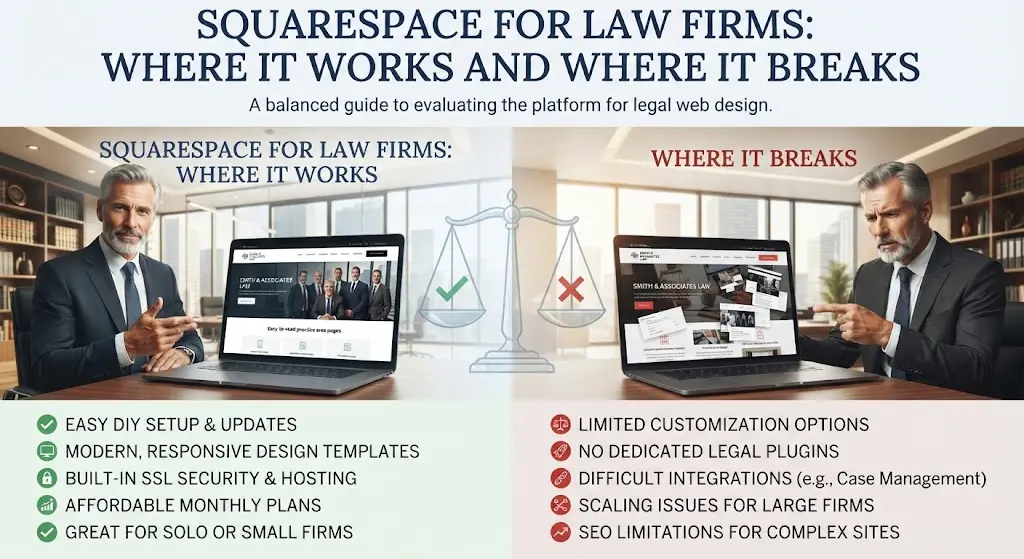
For a closer look at one popular alternative specifically, see Squarespace for law firms: where it works and where it breaks.
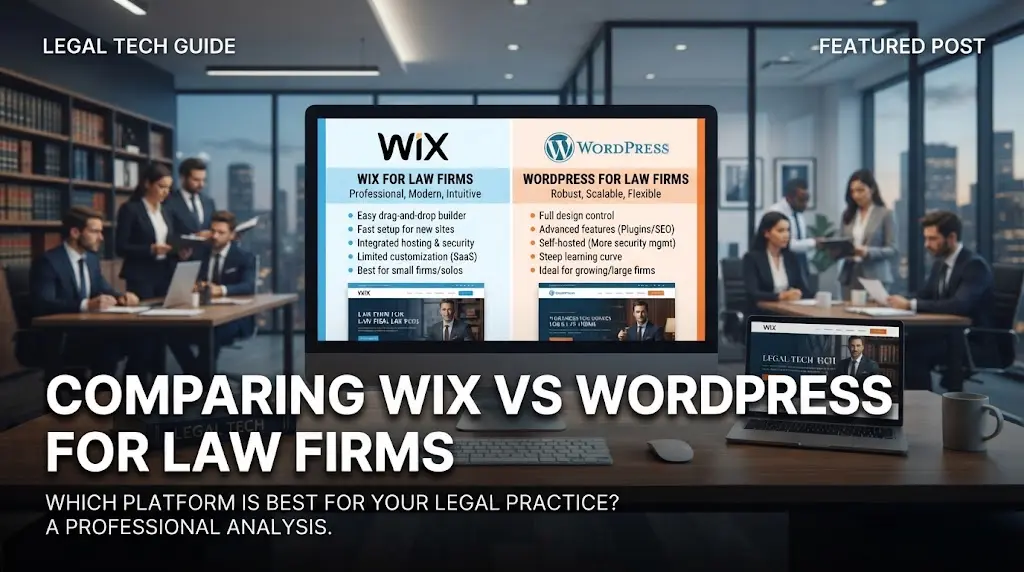
For the specific Wix comparison, see Wix vs WordPress for law firms: a straight comparison.
Common Questions About WordPress for Law Firms
Is WordPress secure enough for a law firm handling sensitive client inquiries?
Yes, when properly maintained — kept updated, backed up, and monitored. The platform itself is not inherently less secure than alternatives; security comes down to how well it is maintained, same as any platform.
Do I need to know how to code to manage a WordPress site?
No. Day-to-day content updates — editing text, swapping photos — use a visual editor. Coding knowledge only becomes relevant for deeper customization, which is exactly what a developer or maintenance plan is for.
Can I move from Wix or Squarespace to WordPress later without losing everything?
Written content can generally be reused, but design and technical structure typically need to be rebuilt — the platforms are not directly compatible with each other.
Does Google favor WordPress sites over other platforms in rankings?
No direct ranking boost exists for the platform itself. The advantage is indirect — WordPress makes it easier to implement the technical SEO that does influence rankings, not that Google treats the platform preferentially.
What’s the difference between WordPress.com and self-hosted WordPress.org?
They are different products despite the shared name. WordPress.com is a hosted, more limited platform closer to a builder. The self-hosted WordPress.org software — what this guide refers to throughout — is what specialist agencies use, offering full plugin access and no platform lock-in.
Bottom Line
WordPress wins for law firm websites on the combination that matters most: full ownership, the deepest SEO ceiling, and the widest ecosystem of tools and developers to support it long-term. See what a specialist-built lawyer website on WordPress includes →
Choosing WordPress is only the first step u2014 finding the right developer to actually build on it matters just as much. See hiring a WordPress developer who knows law firms.
Attorney Website Designers builds every law firm website on WordPress, exclusively for attorneys across the USA. Book a free 15-minute call to see it in action.