
Law firm website development is not the same process as building a site for a restaurant or a retail shop, even though the underlying tools often look identical. Compliance requirements, how legal clients actually search and decide, and the technical foundation needed to rank against competing firms all shape the process differently. This guide walks through exactly how a proper law firm website gets built, step by step — the stack, the roles involved, the realistic timeline, and the decisions that determine whether the finished site actually generates clients or just exists online.
The Law Firm Website Development Process, Step by Step
1. Discovery and Strategy
Before any design work starts, a proper development process begins by mapping your practice areas, target locations, competitors, and the specific searches your ideal clients actually type into Google. Skipping this step is the single most common reason a finished site looks good but does not rank — the site structure gets decided before anyone understood what it needed to compete for.
A useful discovery process should leave you with an actual keyword and competitor list, not just a vague sense of “what the site should be about.” If a developer or agency skips straight to asking about colors and logo preferences without first asking about your practice areas, target cities, and who you are competing against in search results, that is a sign this step is being skipped entirely.
For firms with multiple practice areas or locations, this planning stage is especially critical u2014 see site architecture for multi-practice and multi-office firms for the specific structure to plan around.
2. Sitemap and Content Architecture
Next comes deciding the actual page structure: which practice areas get dedicated pages, how location pages are organized if the firm serves multiple areas, and how everything links together. This architecture, decided before a single page is designed, is what determines how well the site can eventually rank for the searches that matter.
3. Design
With the structure set, design work translates that architecture into an actual visual layout — homepage, practice area page templates, attorney bio layout, and the conversion elements (calls to action, contact forms) that appear throughout. This stage typically takes 1-2 weeks.
4. Development
The design gets built into an actual functioning website — coded or assembled in the chosen platform, made responsive across devices, and wired up with working forms, tracking, and technical SEO foundations like schema markup. This is usually the longest stage, typically 2-3 weeks.
For the complete list of structural foundations that help a finished site actually get found, see website foundations that help a law firm get found on Google.
5. Content
Practice area pages, attorney bios, and homepage copy get written — ideally by someone who understands both legal marketing and how to write for search intent, not generic marketing copy repurposed from a template. This often runs partly in parallel with development to keep the overall timeline reasonable.
6. QA, Compliance Review, and Launch
Before going live, the site gets tested across devices and browsers, forms are verified to actually deliver leads, and required disclaimer and advertising compliance language gets reviewed. Only then does the site launch, with Google Search Console and analytics tracking connected from day one.
This stage should also include a specific check of every disclaimer and contact-form disclosure against your state bar’s current advertising rules — not a generic template disclaimer copied from another site, since requirements genuinely vary by state and by practice area.
The Technology Stack Behind a Modern Law Firm Website
Almost every specialist-built attorney website today runs on the same core stack: WordPress as the content management system, a page builder like Elementor for layout flexibility, an SEO plugin like Yoast for technical optimization, and managed WordPress hosting for performance and security. We cover exactly why this combination has become the standard — rather than a proprietary agency platform or a pure drag-and-drop builder — in why WordPress wins for law firm websites.
Within that stack, you will also choose between a semi-custom template or a fully custom design — see custom build vs template: which law firm website is right for you.
Beyond the core four, a complete stack typically also includes a form plugin for intake (with spam filtering built in), a caching plugin or managed-hosting-level caching for speed, an image optimization tool to keep page weight low, and a backup solution running independently of the hosting provider. None of these are exotic — they are standard, well-tested tools — but skipping any one of them shows up later as a specific, avoidable problem: a slow site, a lost lead from a spam-flooded inbox, or no way to recover from a hosting failure.
For the full list of integrations worth considering beyond the core stack, see website integrations every law firm should consider.
Why this particular stack, rather than a proprietary all-in-one platform some agencies sell? Portability. If the relationship with your developer or agency ever ends, a WordPress-based site can be handed to any other developer without starting over. A proprietary platform locks your site, and often your content, inside that one company’s system.
Realistic Timeline: What to Actually Expect
Combining every stage above, a properly built attorney website typically takes 4-6 weeks from kickoff to launch, with larger multi-location or multi-practice-area projects running 6-10 weeks. For the full week-by-week breakdown of what happens at each stage, see how long a law firm website actually takes to build.
Development Timeline by Project Size
| Project Size | Typical Timeline | Pages Involved |
|---|---|---|
| Solo attorney, single practice area | 3-4 weeks | 5-8 pages |
| Small firm, 2-4 attorneys | 4-6 weeks | 10-15 pages |
| Growing firm, multiple locations | 6-8 weeks | 20+ pages |
| Large multi-attorney firm | 8-12 weeks | 40+ pages |
These ranges assume content — bios, case details, practice area specifics — is provided reasonably promptly. Content delays are the single biggest reason projects run longer than these estimates.
Who’s Involved in a Development Project
A proper build involves more roles than most attorneys expect: a designer handling visual layout, a developer building the functional site, a content writer familiar with legal marketing, and often a project manager coordinating the timeline. At a specialist agency, these roles work together under one roof with a process built specifically around law firm projects. At a generalist agency or freelance setup, you may be coordinating some of these pieces yourself, which is where timelines and quality most often slip.
An SEO specialist is also worth having involved even before development starts — someone deciding page structure and target keywords ahead of design, rather than trying to bolt SEO onto a site after the visual layout is already locked in. At a specialist agency, this role is often the same person handling the discovery stage, which is exactly why discovery and SEO strategy tend to happen together rather than as separate phases.
Development Approaches Compared
| Approach | Best For | SEO Ceiling |
|---|---|---|
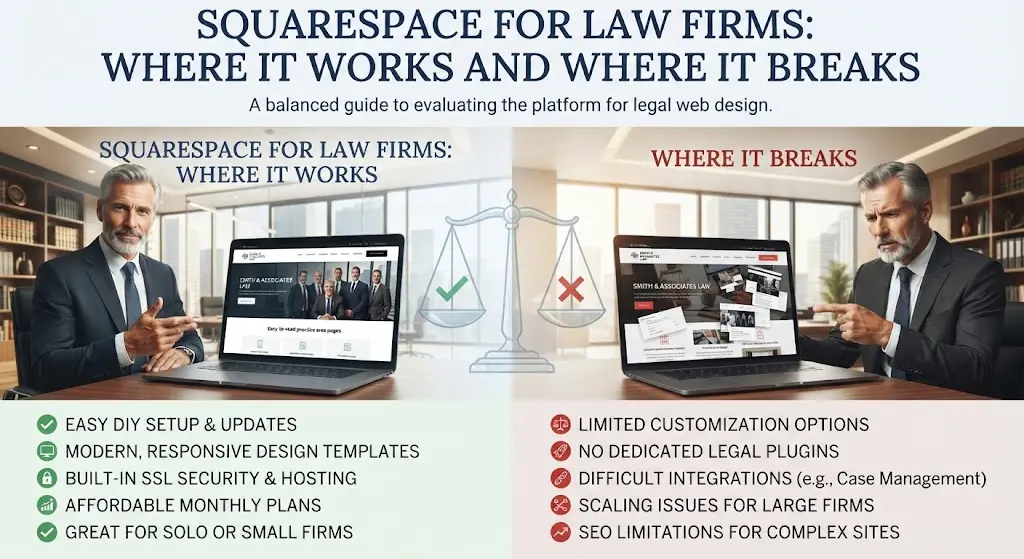
| DIY Builder (Wix, Squarespace) | Zero-budget placeholder | Low |
| Freelance, Template-Based | Very limited budget | Low-Medium |
| WordPress + Page Builder (Specialist Agency) | Most law firms | High |
| Fully Custom-Coded | Large firms with complex needs | Highest, but expensive |
If you are still weighing the DIY route against hiring a developer at all, we cover that full trade-off in attorney website builder: DIY or hire a developer.
What Makes Legal Website Development Different From Any Other Industry
A restaurant website and a law firm website can run on identical technology and still need completely different development decisions. Legal sites require attorney advertising disclaimers built into the page structure, ADA-accessible design as genuine legal-exposure mitigation rather than a nice-to-have, and content architecture organized around distinct practice areas rather than one generic “services” page. For the complete list of what a properly built legal site needs beyond generic web development, see 15 must-have features in law firm website development.
For the complete design-specific guide, see law firm website design: the complete 2026 guide.
Migrating an Existing Site vs Building New
Not every project starts from a blank page. A firm with an existing site that already ranks for some searches faces a different set of decisions than a firm building its first website: what content and rankings need to be preserved through redirects, which pages can be safely restructured, and how much of the existing design and copy is worth keeping versus rebuilding. Migrating a site with existing authority requires more careful planning around URL structure specifically — done carelessly, a migration can lose months of accumulated rankings overnight. Our guide on modernizing your attorney website without losing Google rankings covers this process in detail.
A firm building its first real website, by contrast, has more freedom — there is no existing ranking to protect, so the architecture can be built entirely around what the ideal structure looks like from day one, without compromise for legacy URLs.
What This Actually Costs
Development cost varies by scope, platform, and firm size — from under $1,000 for a solo attorney’s first site to $7,000+ for a multi-location firm with extensive content. Our full breakdown in how much a law firm website costs covers every price tier and what drives the difference.
What Happens After Development: The Post-Launch Checklist
Development does not end at launch. In the first 30 days, watch for how the site is indexing in Google Search Console, confirm forms are reliably delivering leads, and check actual page speed on real mobile devices rather than just a desktop preview. Beyond that first month, ongoing hosting, security updates, and periodic content refreshes keep the site performing rather than slowly degrading. Our guide on law firm website maintenance and hosting covers exactly what that ongoing care should include.
Common Development Mistakes That Hurt Rankings Later
The most common mistake is skipping the discovery and architecture stages entirely — jumping straight to design without first understanding what the site needs to rank for. This produces a site that looks professional but has a page structure fighting against its own SEO potential from day one. Restructuring URLs and page hierarchy after launch is far more disruptive than building it correctly the first time, since it means losing whatever initial indexing and rankings the original pages had accumulated.
A close second is skipping technical SEO setup — schema markup, proper meta tags, Search Console integration — because it is invisible in a demo or screenshot. It only becomes obvious months later, when the site simply is not ranking despite looking finished.
A third common mistake is choosing a development approach based on upfront cost alone without weighing the SEO ceiling of that approach — the comparison table above exists precisely because a cheaper DIY build that caps out at a low SEO ceiling often ends up costing more in the long run through a rebuild, once the firm realizes the site cannot compete for the searches that actually matter.
Signs a Development Team Isn’t Right for Legal Work
A few warning signs show up early, before you have committed anything. If a portfolio has no actual attorney websites in it — only restaurants, contractors, and retail sites — that developer has never worked through the compliance and structural questions specific to legal marketing. If nobody on the team can answer a direct question about how they handle attorney advertising disclaimers, that is not a small gap; it is the exact expertise this guide has been describing throughout. And if the proposed timeline has no discovery or sitemap-planning stage at all — just “design, then build” — expect the finished site to need real SEO rework within the first year.
Choosing a Development Partner
Whether you hire a specialist agency, a generalist, or a freelancer, the questions to ask stay the same: do they understand legal advertising compliance, can they show real attorney website examples, and is SEO foundation actually included rather than sold separately later. Our full vetting checklist is in what to ask before hiring a designer.
Common Questions About Law Firm Website Development
Do I need to be involved throughout the development process, or can I hand it off entirely?
Your input matters most at discovery (practice areas, goals) and content review (bio details, case examples). Most of the technical build can proceed without your day-to-day involvement if you choose an agency with a clear process.
Can an existing website be redeveloped instead of rebuilt from scratch?
Often yes, especially if it is already on WordPress. See our guide on modernizing your attorney website without losing Google rankings for that specific process.
What happens if the development process falls behind schedule?
Content delays — waiting on bio photos, case details, or approvals — are the most common cause. A good agency will flag scope or timeline risk early rather than silently missing the launch date.
Does the development process differ for a firm with multiple locations?
Yes — location page architecture needs to be planned during the discovery and sitemap stages specifically, since it affects both SEO structure and how content gets organized. Bolting location pages onto an existing structure later is more disruptive than planning for them from the start.
Should I involve a marketing consultant separately from the development team?
Not necessarily, if the development team already includes SEO strategy as part of discovery. A separate marketing consultant becomes more useful after launch, for ongoing campaign strategy rather than the foundational site architecture itself.
Bottom Line
Law firm website development is a structured process, not just a design exercise — the discovery and architecture decisions made in the first week determine how well the finished site can compete months and years later. See how we run this process for every project →
Attorney Website Designers builds custom law firm websites exclusively for attorneys across the USA. Book a free 15-minute call to talk through your firm’s development project.